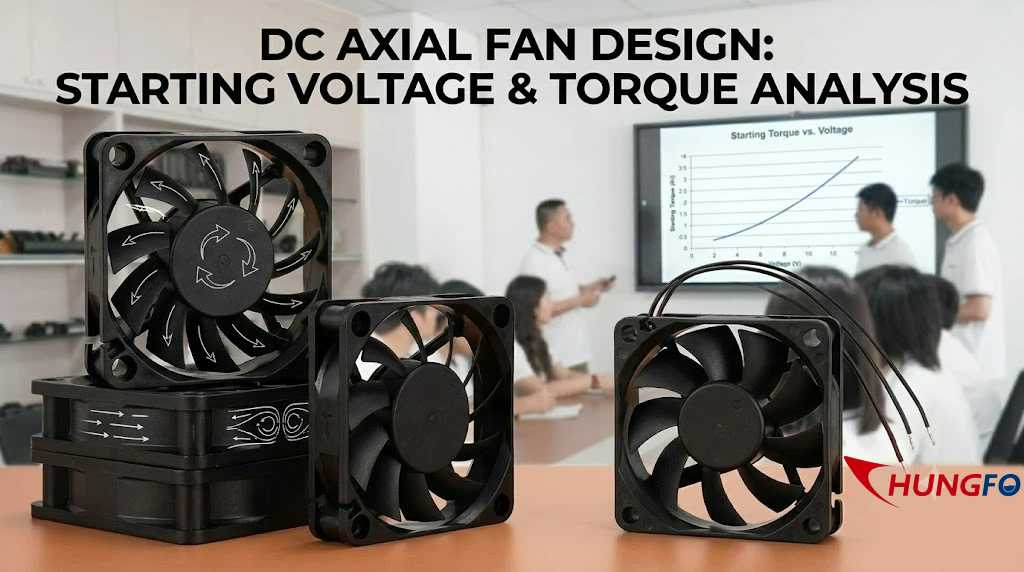
How Input Voltage Affects Starting Torque and Cooling Efficiency?

July 08 , 2026

In the design of modern industrial cooling systems, DC axial fans serve as core temperature control components. Their operational stability and efficiency are directly related to the lifespan and safety of the entire equipment. This is particularly true in communication cabinets, new energy energy storage systems, and automation control devices where 24V axial fans are most widely utilized. However, many R&D engineers and procurement personnel often focus solely on air volume and noise levels under rated conditions during fan selection, while neglecting a vital technical indicator: the starting torque and the decisive impact of input voltage selection on it.


For a standard 24V DC axial fan, starting torque is the key factor that determines whether it can run smoothly at the exact moment the system powers on. In simple terms, starting torque is the initial force released by the motor the moment it goes from a completely stationary state to rotation. If this force is insufficient, the fan cannot overcome the weight and inertia of its own blades, as well as the static friction inside the bearings, which causes the fan to fail to start properly.


The selection and fluctuation of input voltage directly affect the magnitude of the starting torque in a square-proportional relationship through changes in the motor coil current. When the voltage selection or matching of the power supply system deviates, the starting performance of the fan usually presents three completely different states.


The first state is a severe under-voltage condition leading to a failure to start. If the power supply design is improper or the cable loss is too large at the moment of system startup, causing the actual voltage delivered to both ends of the 24V axial fan to fall below 12V, the magnetic field excited inside the motor becomes extremely weak. The starting torque generated by the fan will be less than thirty percent of its rated state. Faced with the static friction inside the bearing, the fan can often only emit a slight current sound but cannot rotate. This prolonged stall state causes the motor coils to heat up rapidly, which can even burn out the circuit.

12v fan


The second state is a slow start at a critical voltage. The designed starting voltage range for most high-quality 24V fans is usually between 12V and 16V. If the power supply voltage remains around 14V for a long time due to high system load, the fan can eventually rotate, but its starting torque is relatively scarce. Consequently, the time required to accelerate from a standstill to the rated speed is significantly prolonged. Under this condition, if the equipment is in a low-temperature environment, the viscosity of the lubricant inside the bearing increases, and a fan that could barely start might become completely unable to rotate.


Beyond the numerical value of the voltage itself, the internal bearing structure of the fan represents a critical variable that dictates the overall starting torque requirements. Industrial cooling fans primarily utilize either ball bearings or sleeve bearings, and each interacts differently with the input voltage during the startup phase. Ball bearings feature a minimal and highly consistent static friction coefficient that remains relatively unaffected by ambient temperature drops. Consequently, they offer a much higher tolerance for lower starting voltages.


On the other hand, sleeve bearings rely on a thin layer of lubricant that can degrade over time. In colder industrial environments, this internal lubricant experiences a drastic increase in viscosity, which can cause the initial static friction to double or even triple. If the power delivery system suffers from a voltage drop under these cold-start conditions, a sleeve bearing fan will almost certainly experience a stall failure. When designing customized thermal management solutions for high-reliability industrial equipment, Chungfo Fan consistently recommends high-grade ball bearing systems to guarantee that the cooling fan achieves a successful first-time start under any unpredictable voltage scenario.


Understanding this delicate relationship between voltage and torque is essential when engineers confront high-heat-density hardware. In these challenging environments, upgrading to a solution that embodies the traits of an EC high-volume cooling fan can deliver both the necessary torque and long-term operational stability. Traditional AC fans can connect directly to high-voltage lines, but their starting torque is difficult to regulate precisely, and their overall energy footprint is remarkably high.


In contrast, modern EC fans integrate intelligent, variable-frequency drive modules directly onto their internal circuit boards. This integrated controller completely mitigates the severe current inrush typically seen during startup while allowing the motor to unleash massive torque at a fraction of the power consumption. This exact balancing act is what drives the industry-leading EC fan energy-saving advantages, making them the preferred choice for forward-thinking green enterprises.


For massive data centers, utility-scale photovoltaic inverters, and high-precision CNC machinery, standard small-volume fans are simply incapable of overcoming the immense system impedance. These demanding setups must rely on a heavy-duty high-power high-volume fan to force sufficient air movement through tightly packed components. Because these high-power fans utilize larger and significantly heavier composite blades, their rotational inertia is immense.


Therefore, when planning the power supply infrastructure for a large-scale high-power high-volume fan application, engineers must carefully calculate the transient startup currents. To ensure these massive blades begin spinning without hesitation, the engineering team at Chungfo Fan integrates advanced soft-start circuits and full-voltage pulse technology into the fan control firmware. During the initial one to two seconds of power-on, the internal chip allows the current to spike safely to its peak, delivering an instantaneous starting torque boost of up to thirty percent beyond standard operation. Once the blade overcomes its static inertia and achieves a stable rotation, the control system smoothly dials the current back down to its nominal operating state. This smart engineering choice protects the fan motor from premature wear while shielding the host equipment's main power supply from disruptive voltage sags.


In conclusion, selecting the voltage for a 24V DC axial fan is never a superficial matter of matching data sheet values. It directly governs the starting torque, which determines the baseline reliability of your entire industrial thermal management ecosystem. In practical applications, ensuring your power supplies have adequate wattage headroom, minimizing cable lengths to prevent line drops, and choosing fans with smart startup capabilities are the most effective ways to eliminate fan stall defects and maximize system longevity.


As a dedicated manufacturer with years of expertise in the cooling industry, Chungfo Fan remains fully committed to delivering premium DC axial fans, state-of-the-art EC high-volume cooling fan units, and tailored thermal solutions to businesses worldwide. No matter how harsh your voltage fluctuations or environmental conditions may be, Chungfo Fan provides the rock-solid starting performance and powerful airflow needed to keep your critical assets running safely.

메일 링리스트에 가입하여 정보를 얻으십시오
메시지를 남겨주세요
메시지를 남겨주세요
IF 우리의 제품에 관심이 있으시고 자세한 내용을 알고 싶습니다. 여기에 메시지를 남겨주세요, 우리는 최대한 빨리 당신을 회신 할 것입니다.

제품

whatsapp