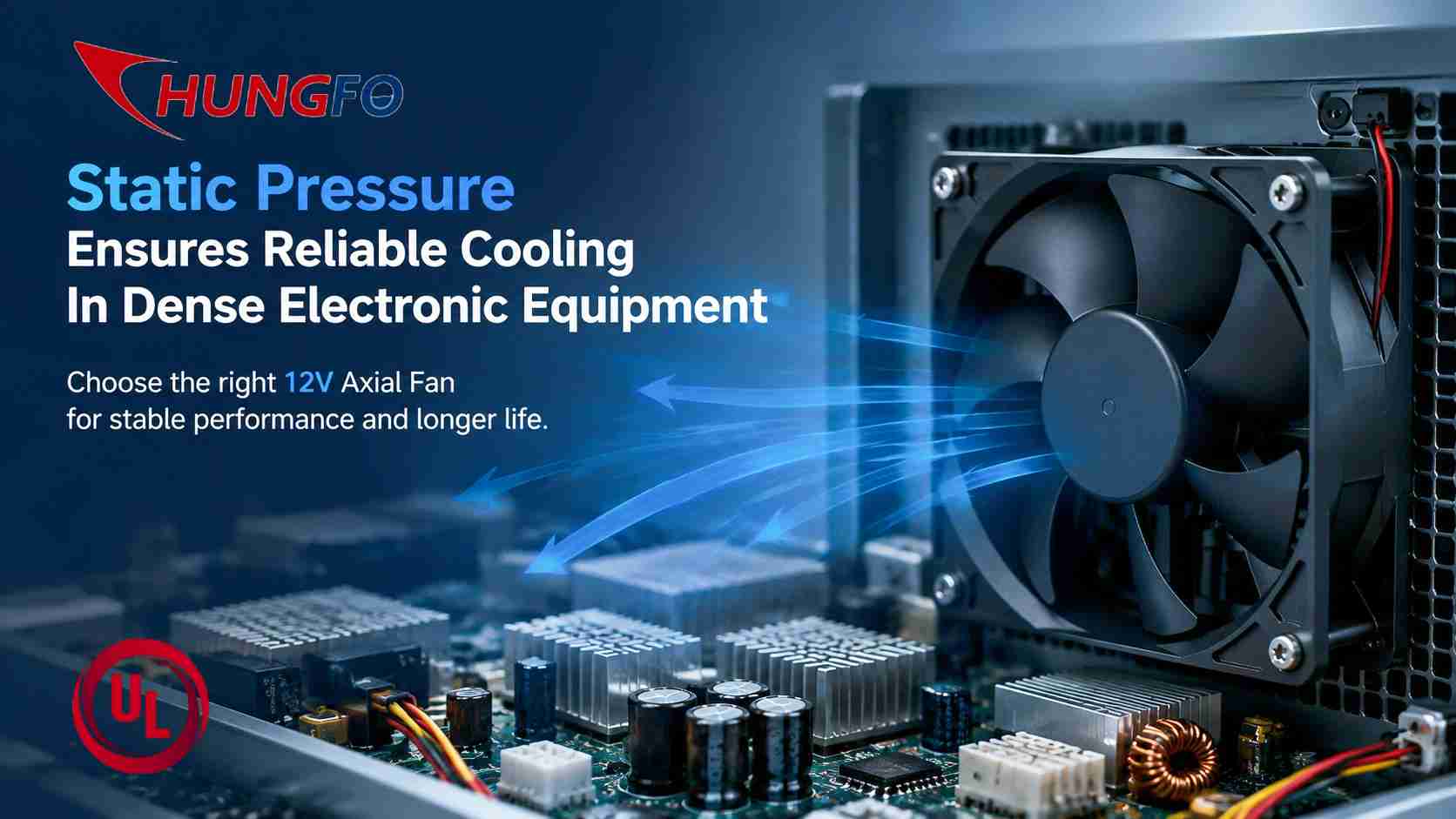
Why Is Static Pressure Crucial When Specifying A 12V Axial Fan For Dense Electronic Equipment?
August 07 , 2026As electronic devices become smaller, more powerful, and increasingly integrated, thermal management has become one of the most important challenges for engineers. Modern electronic equipment often contains high-density components, including processors, power modules, batteries, communication systems, and control circuits. These components generate significant heat during operation, requiring an efficient cooling solution to maintain reliability and extend service life.
When engineers select a cooling fan for compact electronic equipment, airflow is usually the first specification they consider. However, airflow alone cannot determine whether a fan can effectively remove heat from a crowded enclosure. Static pressure is another critical parameter that directly affects cooling performance, especially when using a 12V axial fan in environments with airflow resistance.
For dense electronic systems with limited ventilation space, filters, heat sinks, protective covers, and tightly arranged components can significantly restrict airflow. In these situations, a fan with insufficient static pressure may produce a high airflow rating under open-air conditions but fail to deliver effective cooling inside the actual device.
Therefore, understanding static pressure is essential when specifying a 12V axial fan for demanding electronic applications.
What Is Static Pressure In A Cooling Fan?
Static pressure refers to the ability of a fan to overcome resistance within an airflow system. It represents the pressure difference a fan can generate when moving air through obstacles such as heat sinks, ventilation channels, protective meshes, and internal components.
A fan operating in a completely open environment can move air easily because there is almost no resistance. However, real electronic equipment rarely provides such ideal conditions. Air must pass through narrow spaces, around components, and through structures that create pressure loss.
A cooling fan with higher static pressure can maintain better airflow performance under these restrictive conditions.
This is why engineers cannot evaluate a fan only by looking at its maximum airflow value. A fan with higher CFM but poor static pressure may perform worse than a slightly lower airflow fan when installed inside a compact electronic enclosure.
For example, a high-performance Cooling Fan DC designed for industrial equipment usually focuses on maintaining stable airflow under resistance rather than simply achieving the highest airflow number in an open test environment.
Why Dense Electronic Equipment Requires Higher Static Pressure
Modern electronic products continue to become smaller while their power density increases. This trend creates more complicated thermal management requirements.
Equipment such as industrial controllers, communication devices, power supplies, charging systems, and automation equipment often contains multiple heat-generating components packed into limited spaces.
Several factors increase airflow resistance:
Compact internal structures
Small ventilation openings
High-density circuit boards
Heat sinks and thermal modules
Dust filters and protective grills
Cable arrangements blocking airflow paths
When these factors exist, air cannot move freely through the system. The cooling fan must generate enough pressure to push air through the restricted airflow path.
A 12V axial fan with strong static pressure performance can provide more stable cooling in these environments, helping prevent overheating and improving system reliability.
This is particularly important for equipment operating continuously, where insufficient cooling may lead to component failure, reduced efficiency, or unexpected downtime.
Static Pressure vs Airflow: Which One Matters More?
Airflow and static pressure are two essential fan performance indicators, but their importance depends on the application.
Airflow measures how much air a fan can move in an unrestricted environment. Static pressure measures how effectively the fan can maintain airflow when resistance exists.
For open environments, such as simple ventilation applications, higher airflow may be the priority.
However, for enclosed electronic equipment, static pressure often becomes more important.
A typical example is a server cabinet or industrial control box. The fan must push air through multiple internal obstacles. Even if the fan has a high airflow rating, performance will drop significantly if it cannot overcome the system resistance.
The best cooling solution requires a balance between airflow and static pressure.
Professional fan manufacturers usually provide performance curves showing the relationship between airflow and static pressure. Engineers can use these curves to select a fan that matches the actual system requirements.
Applications Where 12V Axial Fans Require Strong Static Pressure
A 12V axial fan is widely used in electronic and industrial applications because of its compact size, efficient airflow, and easy integration.
Common applications include:
Industrial control cabinets
Power supply equipment
Communication devices
Battery management systems
Charging equipment
Medical electronic devices
Automation equipment
Embedded systems
For example, power conversion equipment generates considerable heat while operating. Internal components such as transformers, capacitors, and semiconductor devices require continuous cooling. A high-static-pressure fan can effectively circulate air and remove heat from these critical areas.
In refrigeration applications, similar principles apply. A specialized deep freezer fan must maintain stable airflow performance despite cold environments, compact structures, and airflow restrictions caused by internal components.
How To Select The Right 12V Axial Fan For Electronic Equipment
Selecting the correct fan requires considering multiple factors instead of focusing on only one specification.
First, engineers should evaluate the internal airflow path of the equipment. Understanding where air enters, where heat accumulates, and where resistance occurs helps determine the required static pressure.
Second, operating conditions should be considered. Temperature range, humidity, dust exposure, and continuous operating time all influence fan selection.
Third, electrical requirements must match the system. Voltage compatibility is important because many electronic devices use 12V DC power systems. A properly matched 12V fan can simplify design and improve energy efficiency.
Noise performance is another important factor. Many modern devices require efficient cooling while maintaining low operating noise. Advanced fan designs use optimized blade structures, precision motors, and improved bearings to achieve better performance.
Finally, selecting a reliable manufacturer ensures consistent quality and long-term supply stability.
Why Professional Fan Manufacturing Matters
The performance of a cooling fan depends not only on design but also on manufacturing precision.
A professional manufacturer must control every stage of production, including material selection, motor assembly, blade balance, electronic control systems, and quality testing.
An unbalanced impeller can create vibration and noise. Poor motor design can reduce lifespan. Inconsistent production quality can lead to unstable airflow performance.
Therefore, working with an experienced fan manufacturer helps engineers obtain reliable thermal solutions.
About Chungfo
Guangdong Chungfo is a professional manufacturer specializing in the research, development, production, and customized manufacturing of cooling fans and thermal management solutions.
The company has established a complete production system covering product design, mold development, injection molding, electronic processing, assembly, and quality inspection. With strong manufacturing capabilities and advanced production technology, Guangdong Chungfo provides reliable cooling solutions for customers worldwide.
Our factory Huitong product range includes DC cooling fans, AC fans, blower fans, centrifugal fans, and cross flow fans, which are widely used in electronic equipment, industrial control systems, household appliances, refrigeration equipment, medical devices, automation equipment, and new energy applications.
With a comprehensive quality management system and professional testing equipment, Guangdong Chungfo is capable of meeting different customer requirements in airflow performance, static pressure, noise control, operating life, and product reliability.
By continuously improving fan design technology and manufacturing processes, Guangdong Chungfo is committed to providing efficient and stable thermal management solutions for global customers and helping modern electronic equipment achieve better cooling performance.
The Future Of Static Pressure Optimization In Cooling Fan Design
As electronic technology continues to develop, the demand for compact and powerful equipment will continue to increase. Thermal management will become even more important in future product designs.
Engineers will need cooling fans that provide not only high airflow but also strong pressure performance, low noise, long service life, and intelligent control functions.
Advanced fan solutions such as PWM-controlled fans and optimized blade designs will provide more precise cooling management.
For dense electronic equipment, choosing the correct 12V axial fan with suitable static pressure is not only a technical decision but also an investment in product reliability.
By understanding airflow resistance and selecting the right cooling partner, engineers can create safer, more efficient, and longer-lasting electronic systems.
Frequently Asked Questions About 12V Axial Fan Static Pressure
What is static pressure in a 12V axial fan?
Static pressure refers to the ability of a fan to overcome airflow resistance inside an equipment system. It indicates how effectively a fan can maintain airflow when air needs to pass through obstacles such as heat sinks, filters, ventilation channels, and densely arranged electronic components.
For a 12V axial fan used in compact electronic equipment, higher static pressure usually means better cooling performance under restricted airflow conditions.
Why is static pressure important for dense electronic equipment?
Dense electronic equipment often contains many heat-generating components within limited space. Internal structures such as circuit boards, power modules, protective covers, and heat sinks can restrict airflow movement.
A fan with insufficient static pressure may provide good airflow performance in open-air testing but fail to deliver enough cooling after installation.
Therefore, selecting a 12V axial fan with suitable static pressure is essential for maintaining stable temperature control and improving equipment reliability.
Is higher airflow always better than higher static pressure?
Not always. The ideal fan depends on the application environment.
High airflow is beneficial in open ventilation systems where there is little resistance. However, electronic devices usually have restricted airflow paths, meaning static pressure becomes equally or even more important.
A cooling solution should balance both airflow and static pressure according to the actual system requirements.
What is the difference between a Cooling Fan DC and a traditional fan?
A Cooling Fan DC uses direct current power and is commonly used in electronic equipment because of its compact design, energy efficiency, and easy integration.
Compared with traditional cooling methods, DC cooling fans provide reliable airflow control and can be customized with functions such as PWM speed regulation, alarm signals, and temperature-based control.
They are widely applied in computers, industrial controllers, communication equipment, power supplies, and other electronic systems.
How do I choose the right Axial Fan 200mm for industrial equipment?
When selecting an Axial Fan 200mm, engineers should consider several important factors, including:
Airflow requirement
Static pressure performance
Operating voltage
Noise level
Installation space
Operating temperature
Expected service life
A larger fan size does not always guarantee better cooling performance. The fan must match the airflow resistance and thermal requirements of the specific application.
Can a 12V axial fan be used for refrigeration applications?
Yes. Many refrigeration systems require compact and reliable cooling solutions. A specialized deep freezer fan must operate effectively under low-temperature conditions while maintaining stable airflow performance.
A properly designed DC axial fan can help improve heat exchange efficiency and support long-term operation in refrigeration equipment.
How does static pressure affect fan lifespan?
When a fan operates in a high-resistance environment without sufficient pressure capability, the motor may experience increased workload, unstable airflow, and higher operating temperatures.
Choosing a fan with suitable static pressure allows the motor and blades to operate more efficiently, reducing unnecessary stress and improving overall service life.
Why should I choose Chungfo Fan for cooling fan solutions?
Chungfo Fan has extensive experience in cooling fan design and manufacturing. The company provides customized solutions for different industries, including electronic equipment, industrial automation, refrigeration, and new energy applications.
With advanced production capabilities, professional testing equipment, and strict quality control, Chungfo Fan helps customers select reliable cooling products that meet their specific thermal management requirements.