실외용 냉방 팬의 IP68 방수 씰 성능 저하를 어떻게 방지할 수 있나요?
September 07 , 2026실외 공기 냉각 팬은 비, 습기, 먼지, 온도 변화, 염수 분무 등 까다로운 환경 조건에서 지속적으로 작동해야 하는 장비에 점점 더 많이 사용되고 있습니다. 통신 캐비닛, 실외 전원 공급 장치, 전기차 충전 장비, 태양광 인버터, 산업 제어 캐비닛, 냉동 시스템, 농업 장비, LED 디스플레이 등 많은 시스템이 열을 제거하기 위해 강제 공기 흐름에 의존합니다. 그러나 이러한 시스템을 실외에 설치할 경우 냉각 성능은 신뢰성을 좌우하는 요소 중 하나일 뿐입니다. 팬이 오랜 기간 동안 물과 먼지로부터 보호되는 능력 또한 매우 중요합니다.
안IP68 등급 팬이 제품은 먼지와 물의 침투를 매우 효과적으로 차단하도록 설계되었습니다. 그러나 IP68 등급은 밀봉 시스템이 영구적으로 변형되지 않는다는 것을 보장하는 것은 아닙니다. 옥외 환경에 노출되면 지속적인 기계적, 열적, 화학적, 환경적 스트레스에 노출됩니다. 시간이 지남에 따라 밀봉재는 탄성을 잃고, 접착제는 노화되며, 케이블 연결부는 취약해지고, 하우징 접합부는 치수 변형이 발생할 수 있으며, 빗물이 직접 장비 내부로 유입되지 않더라도 결로 현상으로 인해 습기가 발생할 수 있습니다.
즉, 실외 공기 냉각 팬을 IP68 방수 씰의 열화로부터 보호하려면 단순히 IP68 라벨이 부착된 팬을 선택하는 것 이상의 완벽한 신뢰성 전략이 필요합니다.
따라서 장비 제조업체와 엔지니어에게 가장 중요한 질문은 팬이 새 제품일 때 IP68 테스트를 통과할 수 있는지 여부뿐만 아니라 팬의 밀봉 구조, 재료, 전기 부품, 베어링, 케이블 연결 및 설치 환경이 예상 수명 기간 동안 안정적으로 작동할 수 있는지 여부입니다.
실외용 냉각 팬에 있어 IP68 등급은 실제로 무엇을 의미할까요?
IP 코드는 고체 입자 및 물에 대한 외함의 보호 수준을 나타내는 데 사용됩니다. 첫 번째 숫자는 고체 입자에 대한 보호 수준을, 두 번째 숫자는 물에 대한 보호 수준을 나타냅니다. IP68은 특정 시험 조건 하에서 높은 수준의 분진 보호와 침수 방지 기능을 제공합니다. IP68 등급과 관련된 정확한 침수 조건은 제조업체가 명시한 시험 조건 및 관련 규정에 따라 달라질 수 있습니다.
이러한 차이점은 실외용 선풍기 선택에 중요합니다.
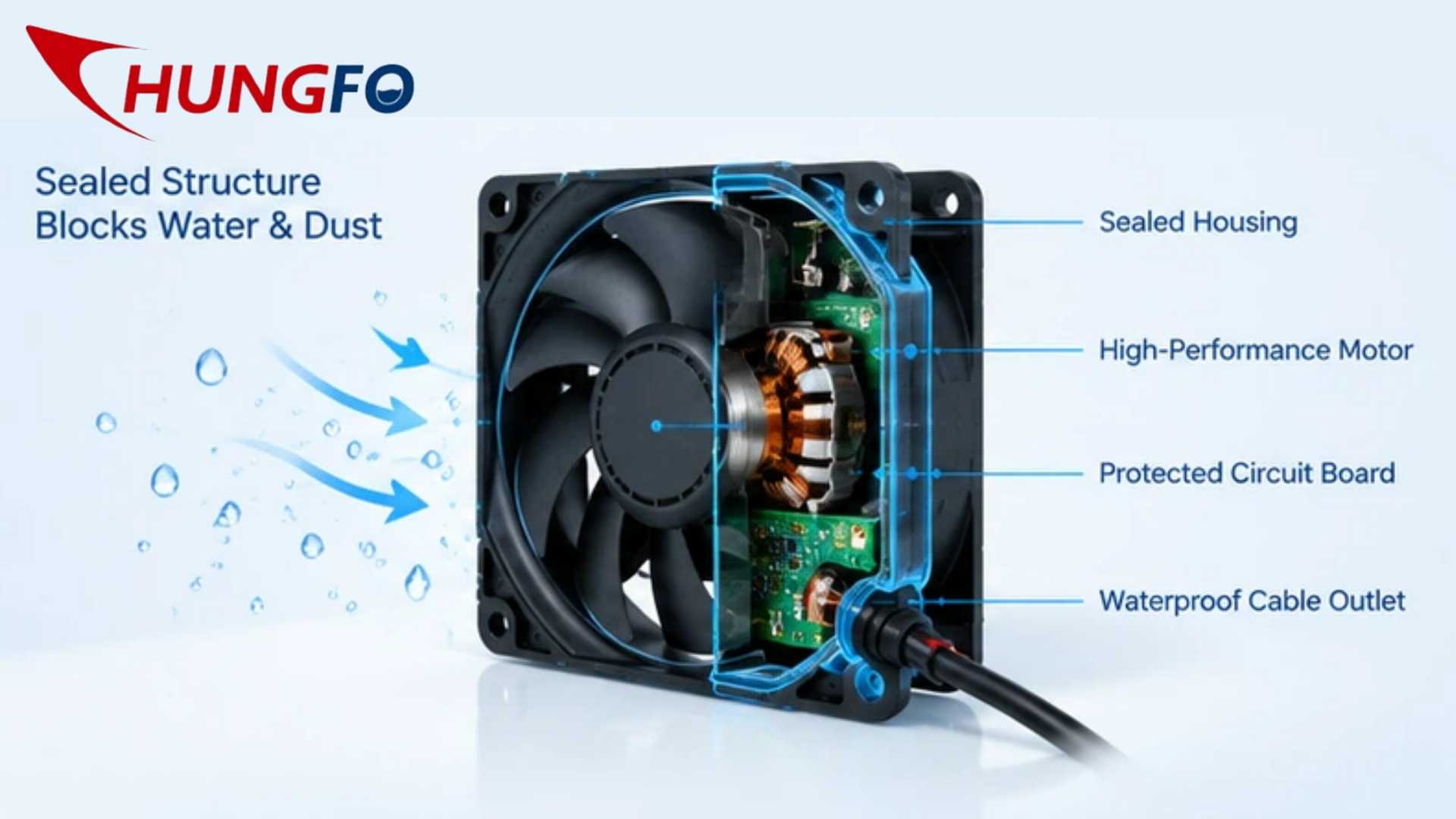
IP68 등급의 팬은 단순히 일반 팬에 고무 덮개를 씌운 것이 아닙니다. 확실한 방수 기능을 확보하기 위해 제조업체는 일반적으로 하우징 이음새, 케이블 출구, 커넥터, 모터 구조, 회로 기판, 베어링 영역 및 기타 연결 부위와 같은 여러 가지 잠재적인 물 유입 경로를 차단해야 합니다.
잘 설계된 방수 팬은 밀폐형 하우징 구조, 수지 보호, 컨포멀 코팅, 방수 케이블 출구, 특수 베어링, 내식성 재료 및 정밀하게 제어된 제조 공정을 조합하여 사용할 수 있습니다. 산업 현장의 사례를 보면 포팅 또는 캡슐화를 통해 권선과 회로 기판을 외부 환경으로부터 격리할 수 있음을 알 수 있습니다.
하지만 생산 테스트 중에 측정된 보호 수준은 특정 시점의 특정 조건을 나타냅니다. 옥외 장비는 반복적인 온도 변화, 진동, 자외선 노출, 화학 물질 오염 및 기계적 스트레스에 노출됩니다. 이러한 요인들은 밀봉 재료의 특성을 점진적으로 변화시킬 수 있습니다.
그렇기 때문에 장기적인 보호는 시스템 차원의 엔지니어링 문제로 간주해야 합니다.
IP68 방수 씰이 시간이 지남에 따라 성능이 저하되는 이유는 무엇일까요?
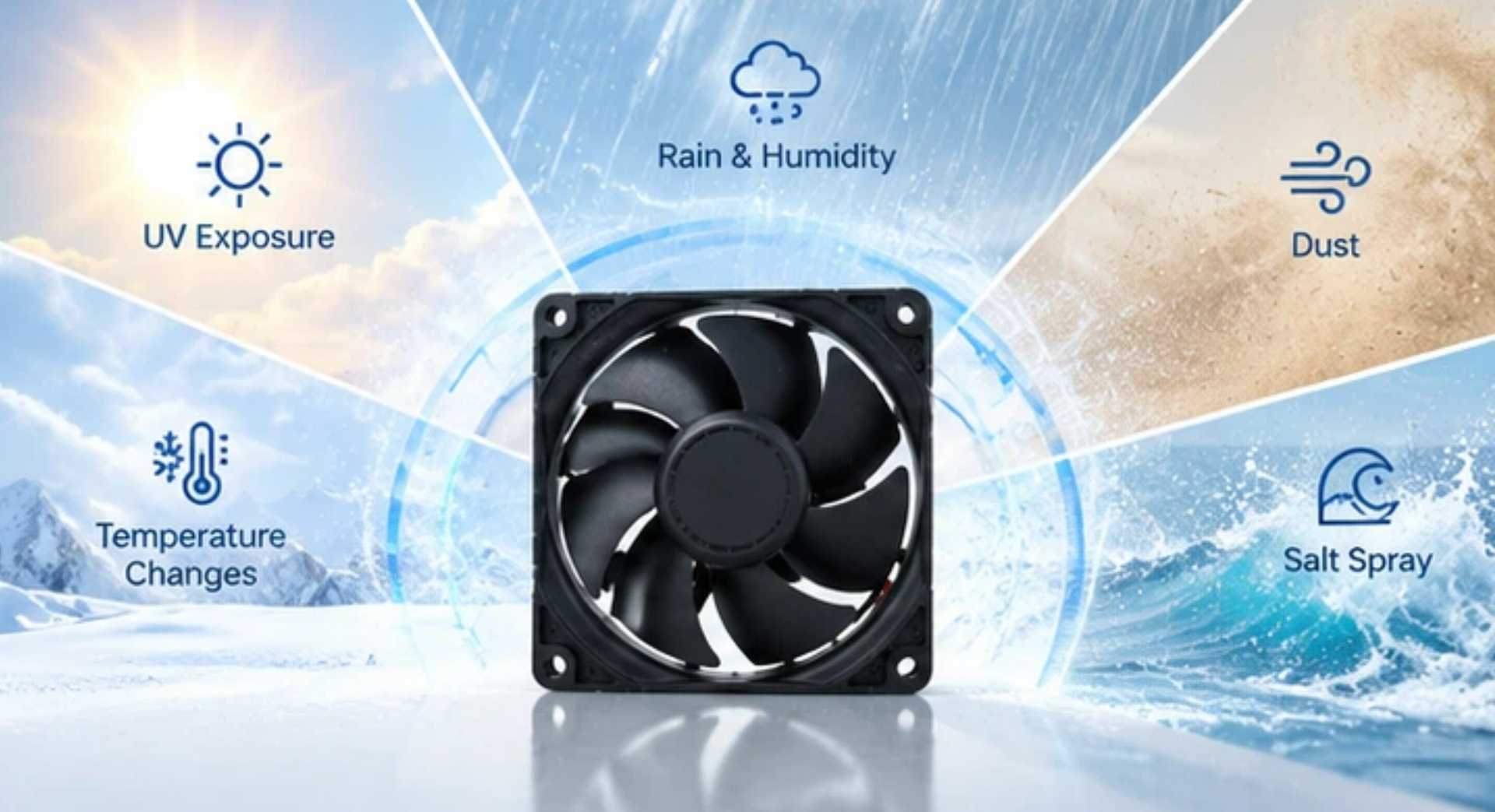
실외 냉방 시스템 설계에서 가장 흔한 실수는 방수 기능이 제품의 영구적인 특성이라고 생각하는 것입니다. 실제로 모든 밀봉 시스템은 주변 환경의 영향을 받습니다.
온도 변화는 가장 중요한 요소 중 하나입니다.
실외용 팬은 추운 밤, 낮의 직사광선, 뜨거운 장비 표면, 갑작스러운 비, 계절별 온도 변화 등 다양한 환경에 노출될 수 있습니다. 플라스틱 하우징, 고무 씰, 접착제, 금속 부품 및 수지 재질은 반드시 동일한 속도로 팽창 및 수축하는 것은 아닙니다.
반복적인 팽창과 수축은 계면에 스트레스를 가할 수 있습니다.
밀봉재가 단단해지거나, 부드러워지거나, 압축되거나, 팽창하거나, 영구적으로 변형되면 접촉 압력이 점차 감소할 수 있습니다. 작은 변화는 당장 눈에 보이는 누출을 유발하지 않을 수 있지만, 반복적인 환경 노출로 인해 습기가 침투할 수 있는 통로를 만들 수 있습니다.
실외 전자 장비 케이스는 압력 변화가 발생할 수 있기 때문에 열 순환 또한 중요합니다. 내부 공기가 가열되어 팽창하고 냉각되어 수축할 때 케이스 내부의 압력이 변동할 수 있습니다. 이러한 열 순환이 장기간 지속되면 밀봉이 약한 부분에 문제가 발생할 수 있습니다. 실외 밀폐형 케이스에 대한 엔지니어링 연구에서는 열팽창 및 수축이 밀봉 불량 및 결로 문제의 주요 원인으로 지목되었습니다.
자외선 노출 또한 우려되는 부분입니다.
실외에 설치된 팬은 수천 시간 동안 직사광선에 노출될 수 있습니다. 재질에 따라 자외선은 변색, 취성, 표면 균열 또는 기계적 특성 저하를 유발할 수 있습니다. 따라서 팬 하우징이나 밀봉 구조가 직사광선에 직접 노출되는 경우 실외 환경에 적합한 재질을 선택하는 것이 중요합니다.
습도는 또 다른 장기적인 과제를 야기합니다.
습한 환경은 직접적인 물 접촉이 없더라도 신뢰성 문제를 야기할 수 있습니다. 습기는 취약한 인터페이스, 커넥터, 케이블 구조 또는 미세한 결함을 통해 침투할 수 있습니다. 또한 높은 습도는 금속 부품 및 전자 접점의 부식을 가속화할 수 있습니다.
염수 분무는 특히 공격적일 수 있습니다.
해안 지역 근처에 설치된 옥외 장비는 공기 중의 염분 입자와 습기에 노출될 수 있습니다. 염분 오염은 금속 부품, 커넥터, 패스너 및 전기 인터페이스의 부식을 가속화할 수 있습니다. 따라서 환경 팬 제조업체는 염수 분무 및 습기가 있는 환경에 적합한 특수 내식성 설계를 제공하는 경우가 많습니다.
먼지는 문제를 더욱 악화시킬 수 있습니다.
먼지 입자는 밀봉 부위와 기계적 접촉면 주변에 축적될 수 있습니다. 먼지에 마모성 또는 화학적으로 활성적인 입자가 포함되어 있으면 반복적인 움직임이나 진동으로 인해 밀봉 표면이 점차 손상될 수 있습니다. 먼지가 습기와 결합하면 제거하기가 더욱 어려운 침전물을 형성할 수 있습니다.
팬 하우징은 방수 씰을 어떻게 보호할 수 있을까요?
팬 하우징은 환경 오염으로부터 보호하는 첫 번째 주요 방어선입니다.
견고한 실외 팬은 불필요한 개구부를 최소화하고 밀폐 인터페이스를 제어하는 하우징 구조를 가져야 합니다. 제어되지 않는 개구부가 적을수록 안정적인 환경 보호 기능을 유지하기가 더 쉬워집니다.
주택 접합부는 신중하게 설계해야 합니다.
접촉면, 개스킷 압축, 공차 및 체결 방법이 적절히 제어되지 않으면 단순한 기계적 접합부는 장기적인 보호에 충분하지 않을 수 있습니다. 설계에 따라 제조업체는 개스킷, 밀봉 화합물, 수지 충진, 포팅, 오버몰딩 또는 기타 기술을 사용할 수 있습니다.
목표는 단순히 하우징을 열기 어렵게 만드는 것이 아닙니다. 목표는 진동 및 열 순환 중에도 기계적 무결성을 유지하면서 물에 대한 안정적인 차단막을 만드는 것입니다.
특히 높은 수준의 환경 보호가 요구되는 응용 분야의 경우, 내부 전자 부품은 코팅 또는 캡슐화를 통해 보호될 수 있습니다. 일부 IP68 팬 설계는 민감한 권선과 회로 기판을 물과 습기로부터 차단하기 위해 수지 기반 기술을 사용합니다.
이러한 접근 방식은 추가적인 보호 계층을 제공합니다.
외부 하우징에 작은 결함이 발생할 경우, 내부 밀봉을 통해 습기가 민감한 전기 부품에 도달할 가능성을 줄일 수 있습니다.
케이블 출구 부분이 방수 처리에 있어 중요한 이유는 무엇일까요?
많은 엔지니어들이 팬 하우징에는 세심한 주의를 기울이지만 케이블 배출구는 간과하는 경향이 있습니다.
케이블은 보호된 내부 영역에서 외부 환경으로 통과해야 합니다. 이러한 전환 과정에서 불가피하게 인터페이스가 발생합니다.
케이블 배출구 설계가 부실하면 물이 케이블을 따라 또는 케이블 진입 지점 주변의 틈새를 통해 스며들 수 있습니다.
이러한 이유로 방수 팬 설계에는 종종 성형 케이블 출구, 밀봉 화합물, 케이블 글랜드, 방수 커넥터 또는 기타 제어된 밀봉 방법이 사용됩니다.
케이블 재질 자체도 중요합니다.
옥외용 케이블은 온도 변화, 자외선 노출, 습기, 굽힘, 진동, 그리고 경우에 따라 화학 물질에도 견뎌야 합니다. 실내에서 우수한 성능을 발휘하는 케이블이라고 해서 옥외에서도 동일한 장기적인 신뢰성을 보장하는 것은 아닙니다.
따라서 케이블과 팬 사이의 연결은 전체 방수 시스템의 일부로 평가되어야 합니다.
보호되지 않은 외부 커넥터가 있는 고품질 IP68 팬을 사용하면 전체 시스템에 취약점이 생길 수 있습니다. 팬 자체는 환경 보호 기능이 뛰어날 수 있지만, 최종 장비 조립 과정에서는 그렇지 않을 수 있습니다.
결로 현상은 IP68 팬의 신뢰성에 어떤 영향을 미칠까요?
방수와 결로는 서로 다른 문제입니다.
직접적인 물 유입은 액체 상태의 물이 개구부나 손상된 밀봉 부분을 통해 유입될 때 발생합니다. 결로는 공기 중에 이미 존재하는 습기가 온도 변화로 인해 액체 상태의 물로 변할 때 발생합니다.
이러한 구분은 특히 실외용 전자 장비에서 중요합니다.
밀폐된 공간 내부에는 습한 공기가 있을 수 있습니다. 낮에는 내부 부품이 작동하여 공기를 가열하고, 밤에는 장비가 냉각됩니다. 이때 내부 온도가 이슬점에 도달하면 차가운 표면에 물방울이 맺힐 수 있습니다.
따라서 열 설계가 제대로 제어되지 않으면 밀폐가 잘 된 공간이라도 내부에 습기가 발생할 수 있습니다.
따라서 실외 팬 시스템은 물 유입 방지 및 습기 관리 모두를 고려해야 합니다.
일부 외함 설계에서는 통기성 멤브레인을 사용하여 액체 수분 침투를 제한하면서 압력 평형을 유지할 수 있습니다. 이러한 솔루션은 신중하게 선택해야 하는데, 추가적인 통풍 부품이 외함의 전반적인 환경 보호 성능에 영향을 미칠 수 있기 때문입니다. IP67 및 IP68 등급 외함에 대한 엔지니어링 지침에서는 장기적인 신뢰성 확보를 위해 압력 평형 및 결로 관리를 강조하는 경우가 많습니다.
온도 변화는 팬 밀봉재에 어떤 영향을 미칠까요?
온도 변화가 반복적으로 발생하는 것은 한 번의 고온 현상보다 장기적으로 더 큰 손상을 초래하는 경우가 많습니다.
전기 캐비닛 내부에 실외 냉각 팬이 작동한다고 상상해 보세요. 낮에는 태양 복사열로 인해 캐비닛 내부 온도가 상승합니다. 내부 전자 부품에서 열이 발생하기 때문에 팬은 고속으로 회전합니다. 밤이 되면 시스템은 빠르게 냉각됩니다.
이러한 과정은 매일 반복될 수 있습니다.
하우징은 팽창하고 수축합니다. 밀봉재는 각기 다른 방식으로 반응합니다. 접착제는 스트레스를 받습니다. 케이블 외피는 치수가 약간 변합니다. 베어링 내부의 윤활유는 온도에 따라 반응합니다. 전자 부품 또한 반복적인 열 스트레스를 받습니다.
Over thousands of cycles, small changes can accumulate.
This is why outdoor fan qualification should consider the actual operating temperature range rather than only the nominal room-temperature condition.
Selecting a fan designed for the expected temperature range can significantly improve reliability.
The thermal design should also consider the difference between ambient temperature and the temperature inside the equipment. A fan operating in a 40°C outdoor environment may be exposed to a considerably higher internal temperature if the enclosure receives solar radiation or contains high-power electronics.
A suitable outdoor fan therefore needs both environmental protection and thermal capability.
How Can Material Selection Reduce Seal Degradation?
Material selection is one of the most effective ways to improve long-term environmental reliability.
Different rubber, plastic, resin, adhesive, and cable materials behave differently under ultraviolet radiation, heat, humidity, chemicals, and salt exposure.
For sealing applications, engineers should consider compression set, temperature resistance, chemical compatibility, water resistance, and aging characteristics.
For fan housings, material selection should consider mechanical strength, dimensional stability, flame resistance, corrosion resistance, ultraviolet exposure, and operating temperature.
For bearings, moisture resistance and lubricant stability are important.
For cables, flexibility, insulation performance, temperature resistance, and environmental durability should be evaluated.
A waterproof fan should therefore be selected as a complete engineered system rather than simply according to its external appearance.
How Important Are Bearings In An Outdoor Cooling Fan?
The waterproof seal protects electrical components, but the bearing system determines how reliably the impeller can rotate.
Outdoor environments can accelerate lubricant degradation and corrosion if the bearing structure is not suitable for the application.
Water exposure can be particularly damaging to conventional bearing systems.
A bearing that performs well in a clean indoor cabinet may experience different conditions in an outdoor agricultural machine, coastal power system, or industrial enclosure.
For long-life outdoor operation, engineers should consider bearing construction, lubricant characteristics, operating temperature, expected rotational speed, vibration, and environmental exposure.
Some manufacturers offer IP68 fans with specially protected ball bearings or other bearing solutions designed for demanding conditions.
The correct bearing selection also helps prevent secondary failures. If a bearing begins to develop excessive friction, the motor may consume more power, the fan may produce more heat, airflow can decline, and vibration can increase.
Therefore, bearing reliability is closely connected with the entire cooling system.
How Can You Protect An Outdoor Fan From Salt Spray?
Coastal installations require special attention.
Salt mist can reach outdoor equipment even when the fan is not directly exposed to seawater. Tiny salt particles can settle on surfaces and remain there when humidity is high.
Over time, salt contamination can accelerate corrosion.
The best strategy is to combine corrosion-resistant materials with appropriate sealing and, where necessary, additional surface protection.
Metal components should be selected according to the expected environmental conditions. Electrical connectors should have suitable environmental protection. The fan housing should prevent unnecessary exposure of sensitive components.
In particularly demanding applications, salt spray testing can provide useful information about material and surface durability.
A fan that is technically waterproof but uses materials that corrode rapidly may still have poor long-term reliability.
Therefore, IP68 should not be treated as a substitute for corrosion resistance.
How Can Installation Prevent IP68 Seal Damage?
Even the best waterproof fan can fail prematurely if it is installed incorrectly.
Mechanical stress is one of the most common installation-related problems.
If the fan frame is mounted against an uneven surface, excessive force can deform the housing. If screws are tightened unevenly, the sealing interface may experience uneven compression.
Cable routing is another important factor.
A cable should not be bent sharply near the sealed outlet unless the design specifically allows it. Excessive bending can place continuous mechanical stress on the cable entry.
The fan should also be positioned so that water does not remain unnecessarily around vulnerable interfaces.
If the application involves pressure washing, the direction and pressure of the water should be evaluated rather than assuming that an IP68 rating means unlimited resistance to every cleaning condition.
Installation instructions should therefore be treated as part of the waterproofing design.
Why Should You Avoid Relying Only On The IP68 Label?
The IP68 rating is valuable, but it is only one part of the product specification.
Two fans can both carry an IP68 designation while having different designs, materials, operating temperature ranges, expected lifetimes, corrosion resistance, bearing systems, and testing conditions.
For an outdoor application, engineers should ask additional questions.
What temperature range can the fan operate in?
What materials are used for the housing and sealing components?
How is the circuit board protected?
How is the cable outlet sealed?
What bearing technology is used?
Has the fan been tested under temperature cycling?
Has it been evaluated for salt spray?
What is the expected service life?
What are the airflow and static pressure characteristics?
Can the manufacturer provide reliability data?
These questions help transform IP68 from a marketing specification into a meaningful engineering parameter.
How Should You Test An Outdoor IP68 Fan?
Testing should simulate the actual environment as closely as possible.
A basic water ingress test is useful, but long-term reliability requires more than one test.
Temperature cycling can evaluate the effect of repeated expansion and contraction.
Humidity testing can help evaluate moisture resistance.
Salt spray testing can provide information about corrosion resistance.
Vibration testing can evaluate mechanical integrity.
High-temperature operation can reveal problems associated with seals, bearings, electronics, and lubricants.
Low-temperature testing can reveal changes in material flexibility and starting behavior.
Combined environmental testing can be even more valuable because real outdoor conditions rarely occur independently.
A fan may experience high temperature, humidity, vibration, and electrical load at the same time.
Manufacturers with appropriate testing capabilities can use environmental chambers, wind tunnel systems, pressure testing equipment, noise testing facilities, and other equipment to evaluate fan performance.
The purpose of testing should not be simply to obtain an IP rating. The objective should be to understand how the product behaves throughout its expected service life.
How Does Airflow Design Influence Waterproof Fan Reliability?
Waterproofing and airflow performance must be balanced.
Adding sealing structures, protective layers, or encapsulation can increase resistance to heat transfer or affect the internal thermal path.
At the same time, excessive restriction of the airflow path can reduce cooling performance.
An outdoor fan should therefore be selected according to the actual airflow and static pressure requirements of the equipment.
For example, asmall 12 volt dc mini fanmay be appropriate for a compact outdoor electronic module, but it may not provide sufficient airflow for a large industrial cabinet with high heat generation.
The key is not simply choosing the fan with the highest RPM.
A fan operating against high system resistance needs sufficient static pressure.
A fan operating in a relatively open airflow path may benefit more from high free-air volume.
This is why the fan performance curve should be considered during product selection.
The fan should be matched to the system operating point rather than selected based only on dimensions.
What Role Does Speed Control Play In Outdoor Fan Life?
Speed control can also contribute to long-term reliability.
If the fan operates at maximum speed continuously, it may generate more noise, vibration, power consumption, and mechanical stress than necessary.
If the equipment temperature varies significantly, variable-speed control can allow the fan to operate according to the actual cooling requirement.
PWM control is one possible method for controlling compatible DC fans.
By reducing unnecessary high-speed operation, the system may reduce mechanical stress and energy consumption.
However, speed control must be properly designed because operating a fan outside its recommended control range can affect starting reliability, acoustic performance, and motor temperature.
The appropriate control strategy depends on the fan design and the equipment requirements.
Choosing The Right Outdoor Fan For Different Applications
Outdoor telecom cabinets often operate continuously and can experience rain, dust, temperature fluctuations, and solar heating. A sealed DC cooling fan can help remove heat while limiting the risk of water and dust entering sensitive areas.
EV charging equipment presents another demanding application. Power electronics can generate substantial heat while the charger is installed outdoors. Waterproof cooling fans can help maintain thermal performance while improving environmental protection.
Solar inverter cabinets can also benefit from environmental fan solutions. Inverter electronics operate under varying outdoor temperatures, and reliable thermal management is essential for stable operation. Water ingress and condensation can create significant risks for electronic components, making environmental protection especially important.
Industrial automation equipment may be exposed to dust, humidity, oil mist, and vibration. The fan must therefore be selected according to the complete industrial environment rather than simply the expected temperature.
Agricultural equipment can face mud, moisture, dust, chemicals, and outdoor temperature fluctuations. In such conditions, corrosion resistance and mechanical durability become particularly important.
Marine and coastal equipment has an even stronger requirement for salt resistance.
Compact electronics may require a small waterproof fan. A Rocket RC Fan concept, for example, may be useful when discussing compact airflow requirements in remote-controlled equipment, hobby electronics, or small mechanical systems, but the exact environmental rating must always be confirmed from the actual product specification.
Why Should Manufacturers Consider Different Fan Structures?
Not every outdoor cooling requirement needs the same fan architecture.
Axial fans are widely used when a relatively large volume of air needs to move through a system with moderate resistance.
Centrifugal fans can be advantageous when the system requires stronger pressure against resistance.
Compact blowers may be useful when airflow needs to be redirected through a narrow duct or confined space.
An ac dc small fan can be useful when equipment requirements involve different power supply architectures or when the application needs a compact fan platform with flexible electrical configurations.
However, the electrical input should always be matched to the actual fan design.
A12V DC fan, a 24 V DC fan, and an AC fan should not be treated as interchangeable simply because their dimensions are similar.
How Can China Chungfo Fan Help With Outdoor Cooling Fan Selection?
For manufacturers developing outdoor electronic equipment, the fan is not an isolated component. It is part of the thermal and environmental protection system.
China Chungfo Fan focuses on cooling fan solutions for different equipment applications and can support requirements involving DC fans, AC fans, axial fans, centrifugal fans, blowers, and customized fan configurations.
The selection process should begin with the actual operating conditions.
The required voltage, airflow, static pressure, installation space, operating temperature, expected lifetime, noise requirement, environmental exposure, and protection level should all be considered together.
For an outdoor project, the application environment should be clearly described.
For example, a fan installed inside a sheltered outdoor cabinet has different requirements from a fan directly exposed to rain. A coastal application has different requirements from an inland factory. A solar inverter exposed to direct sunlight has different thermal conditions from an indoor control cabinet.
The more accurately the environment is defined, the more accurately the fan can be selected.
How Can You Build A Long-Term IP68 Protection Strategy?
The most effective strategy is to treat waterproofing as a lifecycle issue.
Start with the environment.
Identify rain, humidity, dust, salt, ultraviolet radiation, chemicals, vibration, temperature range, and cleaning requirements.
Then identify the thermal requirement.
Determine how much heat the equipment generates and where that heat needs to move.
After that, select the fan structure.
Choose axial, centrifugal, blower, or another design according to airflow resistance and available installation space.
Then evaluate the protection structure.
Look at housing sealing, cable exits, connectors, internal electronics protection, bearings, materials, and corrosion resistance.
Next, consider installation.
Make sure the mounting surface, screws, cable routing, drainage, and airflow direction do not compromise the sealing system.
Finally, test the complete system.
Do not test only the fan in isolation when the real application depends on the interaction between the fan and the equipment enclosure.
This system-level approach can greatly reduce the risk of premature waterproofing failure.
Maintenance Recommendations For Outdoor IP68 Fans
Even a highly protected fan should be included in the equipment maintenance plan.
The fan should be inspected periodically for visible damage, abnormal noise, vibration, corrosion, cable damage, and contamination.
The airflow path should remain clear.
Dust and debris can reduce airflow and increase motor load. If the fan is installed behind a protective grille or filter, that component should also be inspected.
In coastal environments, corrosion should be monitored more frequently.
If unusual vibration or noise appears, the fan should be evaluated before the problem becomes a complete failure.
Maintenance intervals should be based on the application environment rather than a universal schedule.
A clean indoor installation may require minimal inspection, while a coastal industrial installation may require much more frequent checks.
Common Mistakes When Using IP68 Outdoor Fans
One common mistake is assuming that IP68 means the fan can be exposed to any water condition indefinitely.
Another mistake is ignoring condensation.
A third mistake is installing an IP68 fan with a non-waterproof connector.
Another problem is selecting the fan based only on size.
Some engineers also focus on free-air airflow without considering system resistance.
Ignoring temperature is another common error. A fan may survive a short high-temperature event but have a much shorter service life if operated continuously at elevated temperatures.
Finally, some projects evaluate the fan but do not evaluate the complete enclosure.
The final equipment protection level depends on the complete system.
Conclusion
Protecting an outdoor air cooling fan from IP68 waterproof seal degradation requires much more than choosing a fan with a high IP rating.
The long-term reliability of an outdoor fan depends on sealing design, material selection, housing construction, cable protection, bearing technology, corrosion resistance, temperature management, condensation control, installation quality, and environmental testing.
IP68 provides an important level of environmental protection, but it should be viewed as one part of a complete engineering strategy. Real outdoor applications expose cooling fans to thousands of hours of thermal cycling, humidity, rain, dust, vibration, sunlight, and sometimes salt mist. These conditions can gradually influence sealing materials and mechanical components.
The best approach is to select a fan according to the actual operating environment, not simply according to a product label.
For compact electronics, a small waterproof fan may provide an effective balance between airflow and protection. For larger cabinets, engineers may need higher airflow and static pressure. For high-humidity or coastal environments, corrosion resistance and internal electrical protection become increasingly important.
China Chungfo Fan can provide different cooling fan solutions according to application requirements. By combining suitable airflow performance with appropriate environmental protection, equipment manufacturers can create cooling systems that are more reliable, durable, and suitable for long-term outdoor operation.
The key principle is simple: IP68 protection should not be treated as a single specification. It should be treated as a long-term reliability system.
FAQ
What does IP68 mean for an outdoor cooling fan?
IP68 indicates a high level of protection against dust and water ingress under specified testing conditions. The exact immersion requirements should be confirmed from the manufacturer's test specification.
Does IP68 mean a fan will never leak?
No. IP68 describes performance under defined test conditions. Long-term outdoor exposure can affect seals, cables, materials, connectors, and other components.
Why do outdoor fan seals degrade?
Temperature cycling, ultraviolet exposure, humidity, chemicals, salt mist, vibration, mechanical stress, and material aging can gradually affect sealing performance.
Can condensation occur inside an IP68 enclosure?
Yes. Condensation can occur when humid air inside an enclosure cools below its dew point. Waterproofing and condensation management should therefore be considered separately.
Is IP68 enough for coastal applications?
Not necessarily. Coastal environments can involve salt mist and corrosion. Material selection, connector protection, corrosion resistance, and appropriate environmental testing should also be considered.
Why is the cable outlet important?
The cable outlet creates a transition between the internal protected area and the outside environment. Poorly protected cable entries can become a potential water ingress path.
Should an IP68 fan be tested for salt spray?
For coastal or salt-exposed applications, salt spray or other corrosion testing can be useful for evaluating long-term environmental durability.
적합한 실외 냉방 팬을 어떻게 선택해야 할까요?
전압, 풍량, 정압, 온도 범위, 설치 공간, 소음, 예상 수명, 습도, 먼지, 수분 노출, 진동 및 부식 조건을 먼저 고려하십시오. 그런 다음 그에 따라 팬 구조와 보호 등급을 선택하십시오.
소형 12볼트 선풍기는 실외 장비에 적합할까요?
풍량, 정압, 온도 범위, 보호 수준 및 환경 내구성이 적용 요구 사항을 충족하는 경우 소형 장비에 적합할 수 있습니다. 12볼트 DC 미니 팬을 선택할 때는 전압과 크기만 고려해서는 안 됩니다.
방수형 선풍기를 전기차 충전기에 사용할 수 있나요?
예. 방수 또는 환경 보호 기능이 있는 냉각 팬은 풍량, 열 성능, 전기적 특성 및 환경 등급이 해당 용도에 적합한 경우 실외 전기차 충전 장비에 사용할 수 있습니다.
공기 흐름과 IP68 보호 등급 중 어느 것이 더 중요합니까?
둘 다 중요합니다. 방수 기능은 뛰어나지만 풍량이 부족한 팬은 장비를 제대로 냉각할 수 없습니다. 반대로 환경 보호 기능이 충분하지 않은 고성능 팬은 실외에서 조기에 고장날 수 있습니다.
중국 충포선풍기는 야외 선풍기 프로젝트를 어떻게 지원할 수 있을까요?
중국 Chungfo Fan은 제조업체가 적합한 냉각 팬 솔루션을 찾을 수 있도록 애플리케이션의 전압, 풍량, 압력, 크기, 온도, 환경 조건 및 기타 요구 사항을 평가할 수 있습니다.